
How Should Artwork Be Lit to Look Its Best Without Causing Damage?
Artwork should be lit with controlled, low-heat, low-UV light that reveals colour and texture without accelerating fading. While natural daylight shows art in its most accurate colours, it also causes irreversible damage over time. For long-term display, carefully selected artificial lighting is safer and more consistent.
The best lighting for artwork balances visual quality with conservation.
Short Answer: What Is the Best Light for Artwork?
The best light for artwork is high-quality LED lighting with:
No ultraviolet (UV) radiation
No infrared (IR) radiation
Minimal heat output
Controlled brightness
High colour rendering (CRI)
LED lighting reveals colour and texture without causing heat or UV damage.
However, only specific types of LED are suitable for art—many commercial LEDs distort colour and flatten detail.
Why Natural Daylight Damages Artwork
Natural daylight allows artwork to be seen in its most natural state, with minimal colour distortion. However, daylight contains UV radiation, infrared energy, heat, and high light levels—all of which contribute to fading.
Daylight is the most beautiful light and the most damaging light for art.
Fading is caused by:
40% ultraviolet (UV) radiation
25% heat
25% visible light (quantity of light)
10% miscellaneous environmental factors
Because daylight includes all of these, it is unsuitable for long-term display.
Natural light is best for short-term viewing, not permanent presentation.
How to Protect Artwork from Daylight Damage
If artwork is displayed in naturally lit rooms, protection is essential.
Effective measures include:
UV-filtering window films
Mesh blinds or curtains
Limiting exposure during unused hours
Avoiding direct sunlight on artworks
Filtering daylight reduces fading without eliminating natural light completely.
Why LED Lighting Is Best for Artwork
LED lighting is the safest and most effective option for illuminating artwork when selected correctly.
High-quality LED lighting:
Produces no UV or IR radiation
Emits no forward heat
Maintains stable colour over time
Uses up to 10× less energy than incandescent lighting
LED lighting protects artwork while enhancing visual clarity.
However, not all LEDs are suitable for art. Many low-quality LEDs distort colour, flatten texture, and reduce depth.
Only LEDs with high colour rendering and controlled output should be used for artwork.
How Light Affects the Appearance of Artwork
Lighting is not only about safety—it determines how art is perceived.
Correct lighting reveals:
Depth and dimensionality
Surface texture
Fine detail
Colour accuracy
Vibrancy and contrast
Good lighting allows artwork to be seen as the artist intended.
Poor lighting can make artwork appear flat, dull, or incorrectly coloured, even if the artwork itself is exceptional.
When Ceiling-Mounted Accent Lights Work Best
Ceiling-mounted accent lights can be effective when carefully planned and positioned.
They work best when:
The beam angle is controlled
The light is angled to avoid glare and reflections
The fixture is deeply recessed
The distance from wall is correct
Poorly positioned accent lights create reflections and distracting shadows.
Randomly placed spotlights should be avoided, as they break visual focus and create uneven lighting.
When Track Lighting Is the Better Choice
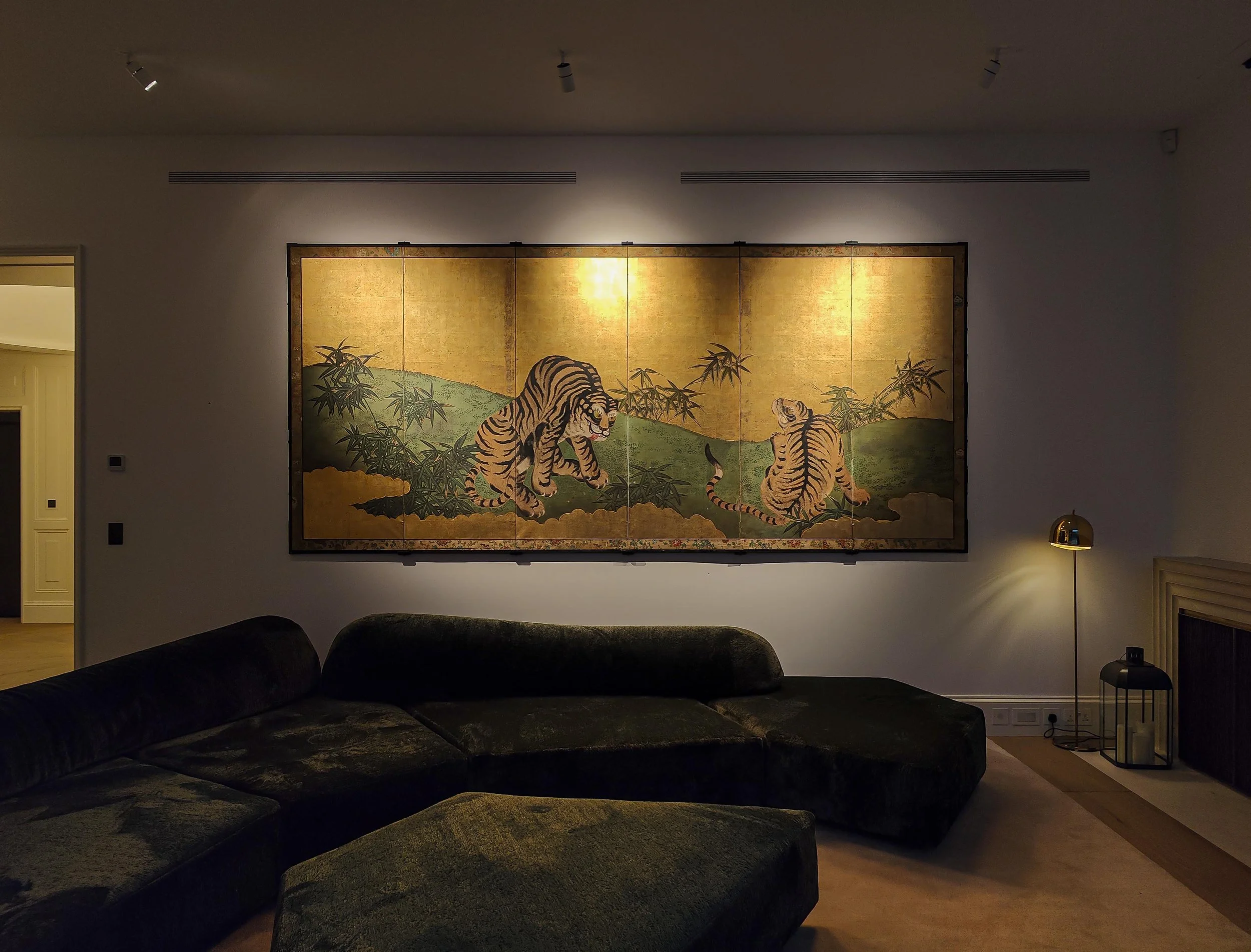
Track lighting is ideal when flexibility is required. It is commonly used in:
Galleries and museums
Contemporary interiors
Homes where artwork changes regularly
A track system allows lights to be moved and adjusted without rewiring.
Track lighting provides adaptable, directional control for changing displays.
When Picture Lights Are the Best Option
Picture lights provide the most controlled and intimate form of art lighting.
They are recommended when:
The artwork is a focal point
Mood and intimacy are important
Precise illumination is required
The wall layout is permanent
Picture lights ensure the artwork remains the visual focus, not the lighting.
Modern picture lights can be minimal and discreet, while traditional finishes suit period or heritage interiors.
The finish of a picture light affects the overall aesthetic of the space.
The Key Principle of Lighting Artwork
Every artwork needs light that is:
Safe for long-term exposure
Appropriate for its medium
Controlled in brightness and direction
Chosen for visual accuracy
The goal of art lighting is visibility without damage.
When lighting is planned correctly, artwork looks better, lasts longer, and feels complete within the space.
Art Lighting – Frequently Asked Questions
What is the best type of light for artwork?
The best type of light for artwork is high-quality LED lighting with no UV or infrared radiation, low heat output, and high colour rendering. This type of lighting protects artwork while showing accurate colour and detail.
LED lighting provides the safest long-term illumination for artwork.
Does natural daylight damage artwork?
Yes, natural daylight damages artwork over time. It contains ultraviolet light, infrared energy, heat, and high light levels, all of which contribute to fading and material breakdown.
Daylight is suitable for short-term viewing but not permanent display.
How does light cause artwork to fade?
Artwork fades due to a combination of ultraviolet radiation, heat, and the total amount of visible light. UV radiation is the single largest contributor to fading.
Fading is caused by exposure, not by the age of the artwork.
Can LED lights damage artwork?
High-quality LEDs do not damage artwork when used correctly. They emit no UV or IR radiation and produce minimal heat. However, poor-quality LEDs can distort colour and cause uneven illumination.
Only art-grade LED lighting should be used for artwork.
How bright should lighting be for artwork?
Artwork should be lit with moderate, controlled brightness rather than strong illumination. Excessive light levels accelerate fading even when UV is filtered out.
Lower light levels protect artwork without reducing visibility.
What colour temperature is best for lighting art?
Neutral to warm white light (around 2700–3000K) is generally best for artwork, as it preserves colour balance and depth. Cooler light can make artwork appear flat or harsh.
Correct colour temperature maintains natural colour perception.
Are spotlights good for lighting artwork?
Spotlights can be effective when properly positioned and recessed to avoid glare and reflections. Poorly placed spotlights create shadows and uneven lighting.
Spotlights require careful planning to work well for art.
When should picture lights be used instead of spotlights?
Picture lights are best used when artwork is a focal point and precise, intimate lighting is required. They provide consistent illumination directly over the artwork.
Picture lights offer the most controlled lighting for individual artworks.
Is track lighting suitable for homes?
Yes, track lighting works well in contemporary homes and in spaces where artwork changes often. It allows flexible repositioning of lights without rewiring.
Track lighting provides long-term flexibility for art display.
How can artwork be protected in bright rooms?
Artwork can be protected by using UV-filtering window films, curtains, blinds, and controlled artificial lighting. Direct sunlight should always be avoided.
Managing light exposure is the key to preserving artwork.
